AI & GRC
Harmonizing Vision and Execution: How Artificial Intelligence Empowers Robust GRC Ecosystems
In an era defined by rapid technological disruption, escalating cyber threats, and an increasingly stringent regulatory landscape, organizations can no longer afford to treat Governance, Risk, and Compliance (GRC) as isolated, reactive administrative functions. Instead, GRC must evolve into a cohesive, strategic ecosystem that mirrors and supports enterprise vision.
6 min read
Abstract
In an era defined by rapid technological disruption, escalating cyber threats, and an increasingly stringent regulatory landscape, organizations can no longer afford to treat Governance, Risk, and Compliance (GRC) as isolated, reactive administrative functions. Instead, GRC must evolve into a cohesive, strategic ecosystem that mirrors and supports enterprise vision. Artificial Intelligence (AI) has emerged as the definitive catalyst in this evolution, bridging the gap between high-level board vision and granular operational execution. This article explores how AI-driven frameworks enable organizations to streamline governance, anticipate risks proactively, automate compliance, and align their organizational vision with sustainable, resilient operations.
1. Introduction: The Modern GRC Imperative
Traditional GRC frameworks have long suffered from organizational silos. Legal teams, risk officers, compliance managers, and internal auditors frequently operate on disparate systems, utilizing manual workflows that struggle to keep pace with dynamic global markets. Consequently, executive vision—focused on agility, innovation, and stakeholder trust—often clashes with the rigid, tick-the-box nature of legacy compliance. Enter Artificial Intelligence. By harnessing machine learning (ML), natural language processing (NLP), and advanced predictive analytics, modern enterprises are transforming GRC from a cost center into a strategic differentiator. AI provides the computational power and analytical precision needed to harmonize risk appetite with corporate strategy, ensuring that every layer of the organization moves in lockstep toward shared objectives.
2. Bridging Strategy and Execution: How AI Aligns Corporate Vision
Aligning vision with GRC requires translating overarching corporate goals into actionable, measurable controls. AI facilitates this alignment through several core mechanisms:
• Dynamic Policy Translation: NLP models can ingest newly passed legislation or corporate strategic mandates and automatically map them to existing internal controls, highlighting gaps or conflicts in real time.
• Unified Data Architecture: AI breaks down departmental silos by aggregating data across enterprise resource planning (ERP), customer relationship management (CRM), and cybersecurity monitoring tools into a single, cohesive risk intelligence hub.
• Board-Level Decision Support: Executive dashboards powered by predictive analytics offer leadership clear visibility into how risk exposures impact long-term strategic milestones, enabling data-driven governance.
3. Visualizing the AI-Driven GRC Ecosystem
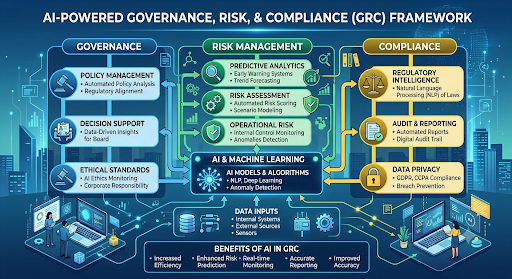
Figure 1: Conceptual architecture of an AI-enhanced GRC ecosystem integrating governance, risk management, and compliance workflows.
4. Core Pillars of AI Integration in GRC
A. Intelligent Governance
Governance sets the tone at the top. AI enhances governance by streamlining board reporting, automating policy lifecycle management, and monitoring ethical culture through sentiment analysis and communication monitoring. Board members gain access to synthesized summaries of enterprise risk profiles, allowing them to steer the company with greater confidence and foresight.
B. Predictive Risk Management
Reactive risk registers are obsolete in the face of fast-moving global risks. AI-driven risk management utilizes predictive modeling to simulate emerging threats—ranging from supply chain bottlenecks to sophisticated cyber attacks. By quantifying potential impacts before they materialize, organizations can proactively allocate resources and adjust strategic trajectories.
C. Automated Compliance and Continuous Monitoring
Compliance is notoriously labor-intensive. Machine learning algorithms automate controls testing, monitor transactions for anomalies, and flag regulatory non-compliance instantly. Continuous auditing replaces periodic sampling, drastically reducing compliance costs while elevating accuracy and assurance.
5. Implementation Challenges and Best Practices
While the benefits of AI in GRC are profound, successful adoption requires navigating specific challenges:
1. Data Quality and Bias: AI models are only as reliable as the data they ingest. Organizations must establish rigorous data governance standards to prevent algorithmic bias.
2. Explainability (XAI): Regulatory bodies and auditors demand transparency. Black-box AI models are insufficient; organizations must deploy explainable AI frameworks where decision pathways are auditable.
3. Human-in-the-Loop Oversight: AI should augment, not replace, human judgment. Experienced GRC professionals must retain ultimate authority over critical risk decisions and policy enforcement.
6. Conclusion
The integration of Artificial Intelligence into GRC ecosystems represents a fundamental paradigm shift for modern enterprise management. By unifying disparate functions, automating routine compliance tasks, and providing predictive insights into emerging risks, AI empowers companies to maintain a robust defense while aggressively pursuing their strategic vision. Ultimately, organizations that embrace AI-driven GRC will not only safeguard their operations against uncertainty but also build enduring trust with stakeholders, regulators, and customers alike.